Agentic AI Foundation Launches: Unified Framework for AI Agent Development
The Linux Foundation launches the Agentic AI Foundation, hosting critical agent infrastructure including Microsoft's unified Agent Framework, establishing the governance foundation for autonomous AI workflows.
By AI Mastermind Lab · Published 5 Feb 2026
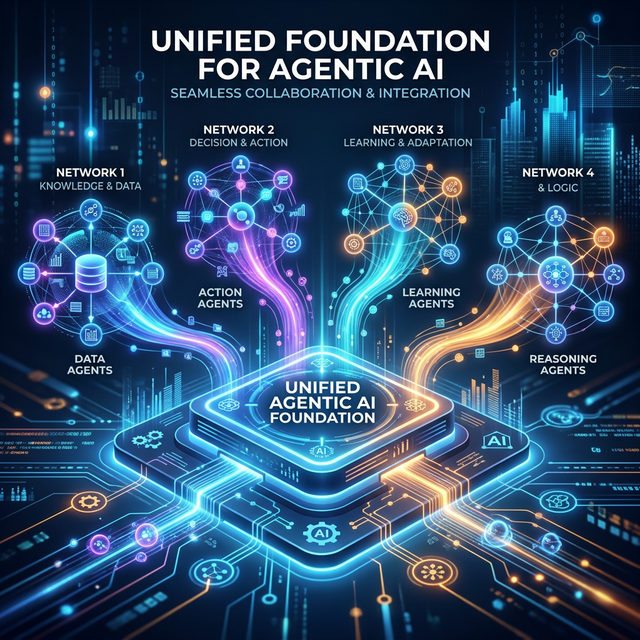
Agentic AI Foundation: Industry Coordination at Scale
The Agentic AI Foundation (AAIF) became operational in December 2025 as a Linux Foundation initiative, marking a watershed moment in AI infrastructure governance. The foundation provides neutral ground for competing organizations to collaborate on fundamental agent technologies while maintaining distinct competitive strategies.
Core Projects Under AAIF Governance
The foundation hosts several critical projects that define the agent ecosystem landscape:
Model Context Protocol (MCP) provides the technical standard enabling AI models to safely interact with external tools and services, with 97M+ monthly SDK downloads as documented elsewhere in this publication.
Block's Goose represents an open-source agent framework optimized for autonomous workflows, contributing pattern libraries and best practices for agent design.
OpenAI's AGENTS.md provides semantic specifications for agent interfaces, enabling agents to discover capabilities and coordinate operations with each other.
Microsoft's Unified Agent Framework
Microsoft has consolidated its agent development infrastructure into a unified Microsoft Agent Framework, achieving general availability in Q1 2026. This framework merges AutoGen—Microsoft's multi-agent orchestration platform—with Semantic Kernel, which provides abstraction layers for semantic operations and memory management.
The unification eliminates duplication and conflicting abstractions that would otherwise fragment the development experience. Developers can now build sophisticated agent systems using a coherent toolkit rather than navigating competing tools with overlapping functionality.
Transition from Chatbots to Autonomous Workflows
The organizational focus on agentic AI reflects a fundamental shift in how AI systems are being deployed. Chatbot interfaces—reactive systems waiting for user input—are giving way to autonomous workflows where AI systems proactively plan, execute, and monitor multi-step processes. This transition requires different architectural approaches focused on reliability, transparency, and control.
Organizations like CrewAI, which provides multi-agent orchestration, and LangGraph, which enables complex agent state management, are evolving rapidly to support this architectural transition. These frameworks are moving from research prototypes toward production-grade tooling.
Why 2026 Matters for Agentic AI
The establishment of the Agentic AI Foundation and proliferation of specialized frameworks indicate that the industry has achieved sufficient clarity about agent requirements to standardize around common patterns. This clarity enables teams to move beyond experimental deployments and build scalable, maintainable agent systems.
Practically, this means organizations can now:
- Adopt best practices established by multiple implementations
- Build on standardized protocols that function across model providers
- Invest in agent infrastructure with confidence that their investments remain portable as technologies evolve
- Participate in communities around open-source agent frameworks
TL;DR
The Agentic AI Foundation (AAIF) now hosts MCP, Goose, and AGENTS.md. Microsoft's unified Agent Framework GA Q1 2026. Agentic AI moving from experimental chatbots to production autonomous workflows.