Model Context Protocol Becomes AI Industry Standard, Adopted by OpenAI and Google
Anthropic's Model Context Protocol has achieved 97M+ monthly SDK downloads and industry-wide adoption, becoming the foundation for agent interoperability across AI ecosystems.
By AI Mastermind Lab · Published 25 Feb 2026
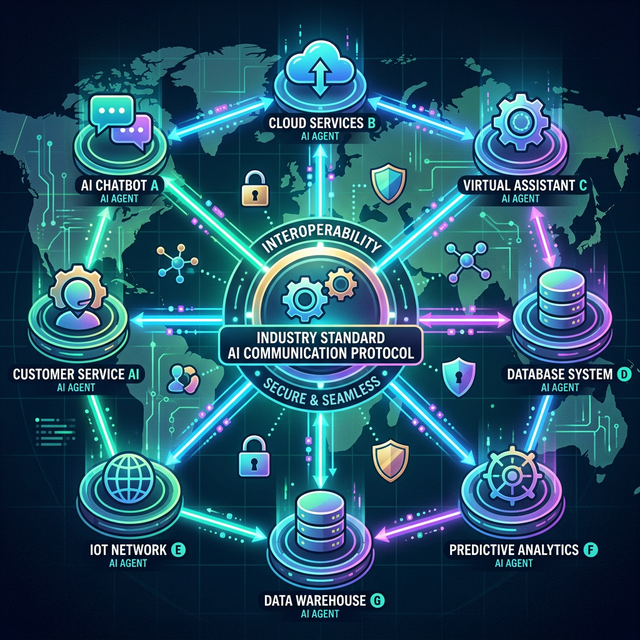
MCP: From Anthropic Initiative to Industry Standard
The Model Context Protocol (MCP), created by Anthropic in November 2024, has achieved unprecedented adoption across the AI industry, accumulating over 97 million monthly SDK downloads as of early 2026. This rapid adoption reflects the protocol's effectiveness in solving a fundamental challenge: enabling seamless interoperability between AI models and external tools, data sources, and services.
Industry-Wide Adoption Signals Consensus
What makes MCP's adoption particularly significant is its breadth. OpenAI, Google DeepMind, and Microsoft have all adopted MCP as a foundational element of their AI infrastructure. This level of agreement among competing organizations is rare in software, typically occurring only when a technology addresses a truly fundamental need that transcends competitive differences.
MCP functions as a standardized communication layer enabling AI models to safely and reliably interact with external systems—databases, APIs, file systems, and specialized services. By providing a common interface, MCP eliminates the friction of building custom integrations for each model-service combination.
Foundation and Governance Transition
In December 2025, Anthropic donated MCP to the Agentic AI Foundation (AAIF), positioning it under the governance structure of the Linux Foundation. This transition from corporate control to open foundation stewardship strengthens MCP's long-term viability and signals confidence in its status as a foundational technology.
The AAIF itself was co-founded by Anthropic, Block, and OpenAI—three organizations with distinct competitive interests united around the importance of agent interoperability standards. This partnership structure legitimizes MCP as a truly industry-neutral technology.
AGENTS.md Adoption and "USB-C for AI"
In parallel, the AGENTS.md standard—also donated to AAIF—has been adopted by 60,000+ open-source projects. AGENTS.md provides semantic conventions for describing agent capabilities and interfaces, complementing MCP's technical protocol layer. Together, these standards are creating an ecosystem where AI agents can discover, communicate with, and delegate tasks to each other seamlessly.
The comparison to USB-C is apt: just as USB-C unified charging and data transfer across diverse devices, MCP and AGENTS.md are unifying how AI agents interact with tools, services, and each other. This standardization enables network effects where each new integration becomes exponentially more valuable.
Practical Impact on AI Development
For practitioners and developers, MCP adoption means that work invested in building model-agnostic integrations becomes genuinely portable. An MCP server built for file system access works identically whether called from Claude, GPT, or Gemini models. This portability reduces development friction and encourages investment in integration quality.
The 60,000+ projects adopting AGENTS.md indicate that the open-source community has embraced these standards as best practices, creating positive feedback loops toward further adoption.
TL;DR
MCP now has 97M+ monthly downloads and industry adoption from OpenAI, Google, and Microsoft. Donated to the Agentic AI Foundation, it's becoming the standard protocol enabling AI agents to interact with tools and services.