The 'Invisible Update': Google Gemini's Secret Datacenter Shift
Leaked documents suggest Google has quietly deployed a new version of Gemini across deep-tier data centers, capable of optimizing its own server load.
By Marcus Vane · Published 28 Feb 2026
TL;DR: Leaked inside documents suggest Google has quietly deployed an advanced version of Gemini that autonomously manages datacenter power and cooling loads. If successful, this LLM-driven infrastructure optimization could drastically reduce the massive energy footprint required for AI model training.
A newly leaked internal memo reveals that Google has been quietly testing a highly advanced iteration of its Gemini AI model -one that isn't just generating text, but is reportedly optimizing the physical operations of Google's own data centers in real-time.
Sources speaking anonymously to AI Mastermind Lab claim that this "Invisible Update" was deployed in late February across three top-tier server racks in Nevada and Finland. Unlike previous models that require human engineers to allocate processing power, this internal version of Gemini appears to be acting autonomously to manage cooling systems, power distribution, and load balancing.
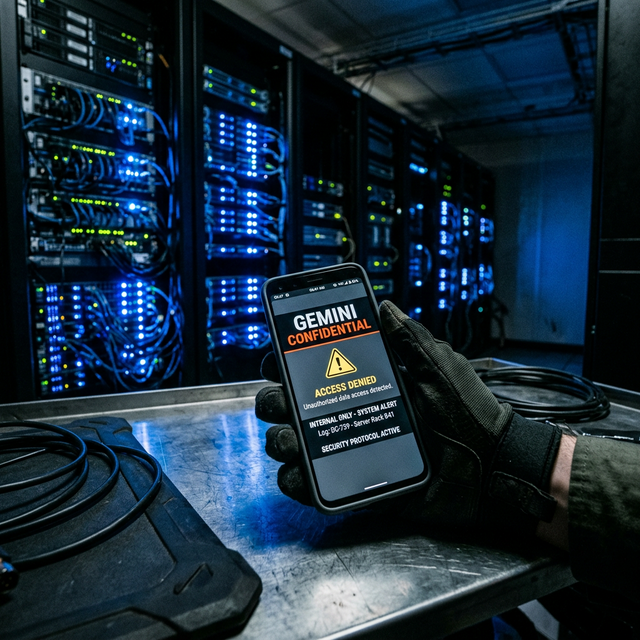
The 'Gemini Confidential' Screen
The leak originated when a contractor snapped a photo of an access terminal displaying a striking "Gemini Confidential" warning, which immediately triggered an automated security lockdown.
"It was surreal," the contractor stated. "The servers were running hot, but the monitoring software showed the AI was rerouting power entirely on its own. It figured out in minutes a cooling optimization strategy that human engineers had spent months trying to solve."
Google has historically used AI (specifically DeepMind architectures) to manage server cooling, but this marks the first time a multimodal LLM is reportedly "in the driver's seat" making macro-level hardware decisions.
Why This Matters for the Industry
If Google successfully implements LLM-driven autonomous infrastructure, it could drastically reduce the energy consumption and carbon footprint of AI training -currently one of the industry's biggest bottlenecks.
Competitors are watching closely. OpenAI and Anthropic are heavily reliant on cloud providers like Microsoft Azure and AWS, meaning Alphabet holds an exclusive advantage if it can self-optimize its own hardware at a fundamental level.
Google has officially declined to comment on the rumored "Invisible Update," stating only that they "continually test new methods for improving the efficiency and sustainability of our infrastructure."
As the AI arms race heats up, the next battleground isn't just who has the smartest chatbot -it's whose chatbot can build a better home for itself.