The High School That Banned AI... And What Happened Next
Oakridge High enacted a strict, no-exceptions ban on all AI tools. Six months later, the results have shocked both tech enthusiasts and traditionalists.
By Elena Rostova · Published 25 Feb 2026
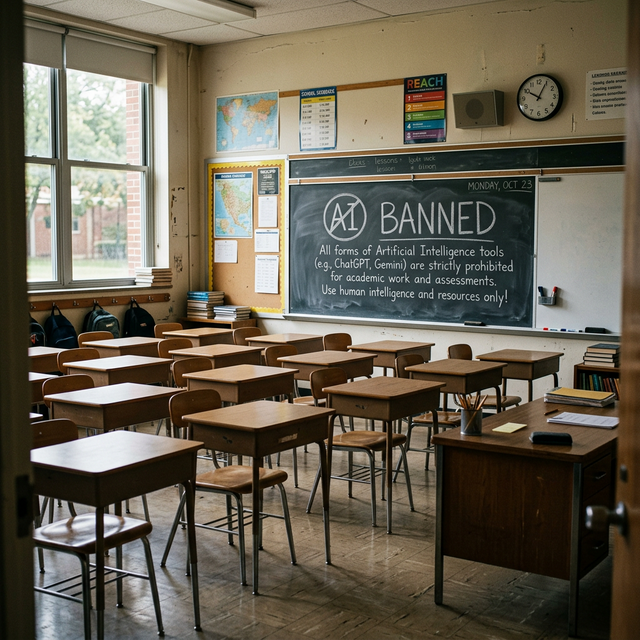
TL;DR: Oakridge High completely banned generative AI tools like ChatGPT for six months. While students initially struggled and a black market of physical AI prompts emerged, the school surprisingly reported a sharp increase in original thought and student library usage before eventually deciding to replace the ban with an AI literacy curriculum.
When Oakridge High announced a zero-tolerance policy against artificial intelligence tools last September, it made international headlines. The principal famously painted a massive "AI BANNED" sign on the main hallway chalkboard. No ChatGPT. No Gemini. No Claude. Any student caught using generative AI for assignments would face immediate academic probation.
Six months into the bold experiment, the results are in -and they are not what anyone expected.
A Return to Pencil and Paper
The first month was chaotic. Teachers reverted to 1990s-style assessments: in-class, handwritten essays, and oral presentations without slide decks. The school disabled access to major tech domains on the campus WiFi and required students to complete complex math and science projects under strict supervision.
"We thought it was going to be a disaster," said AP History teacher Mrs. Albright. "The kids were furious. They felt like we were taking away their calculators right before the SAT."
The Unexpected Outcome
But by month three, a surprising shift occurred. While overall assignment submission rates initially dropped, the quality of original thought began to rise.
Without the crutch of an LLM to generate generic outlines or synthesize research, students were forced to formulate their own arguments. The school reported a 40% increase in students attending after-school tutoring and utilizing the physical library.
"I hated it at first," admitted junior Maya T. "But when I had to write my civics paper by myself... I actually cared about my argument. I wasn't just copy-pasting what an AI thought a good argument was."
The Black Market of Prompts
However, the ban also birthed an underground economy. Tech-savvy students who lived off-campus began selling "clean" AI outputs to desperate peers, printed out physically to evade digital detection.
The administration realized that while they could control the classroom, they could not control the reality of the world outside its walls.
"We learned that a total ban isn't the solution, it's just a pause button," the Oakridge Principal shared in a recent newsletter. "We bought ourselves time to figure out what human intelligence looks like when it's not competing with a machine. Now, we have to transition to teaching them how to use AI responsibly, instead of pretending it doesn't exist."
Starting next semester, Oakridge High is lifting the total ban and replacing it with an "AI Literacy" curriculum, proving that while you can ban technology from the classroom, you can't ban it from the future.